By: The Capella University Editorial Team with Irene Abrego Nicolet, PhD, NCSP, LSSP, Vice President and Dean of the School of Social and Behavioral Sciences
Reading Time: 13 minutes
Job growth projections and salary figures are drawn from Lightcast data and reflect national trends. Actual outcomes vary based on factors such as experience, industry, location, skills and economic conditions, and are not representative of Capella University graduate results.
Therapy can be a rewarding career if you’re looking for a meaningful way to support people as they navigate mental health challenges, relationships and other life circumstances. It’s a diverse profession that includes a wide range of specialist roles and employment settings. To become a therapist, you’ll generally need a bachelor’s degree, a relevant graduate degree, supervised clinical experience and a passing score on your state’s required licensing exam. Different therapy specializations follow different licensing pathways, and requirements vary from state to state.
Before you choose a pathway, think about the type of people you want to work with, the kind of work you’d like to do and what the requirements look like.
Explore what therapists do, the degrees and training you may need, how licensing works and what to consider as you plan your next step.
Key takeaways
- You must generally earn a master’s degree: Most pathways require a relevant master’s degree, supervised clinical experience, a licensing exam and state licensure
- The right degree depends on your specialty: Different therapy specializations have their own education and licensing requirements
- Licensure requirements vary by state: The number of supervised hours, required exams and other licensing requirements differ depending on which state you plan to practice in
- Online education can offer flexibility: Online programs can help balance education with work and other responsibilities while developing relevant knowledge and skills
What is a therapist and what do they do?
Therapists are licensed professionals who assess and treat mental and emotional health challenges. Within therapy, practitioners specialize in different approaches and populations, from marriage and family therapy to psychotherapy. Each specialization has its own training and licensing route.
Therapists work across a variety of settings to support clients, using a systemic lens in their approach. This approach is based on five broad categories:
- Psychoanalysis and psychodynamic therapies: Focus on helping clients uncover how unconscious thoughts influence their behaviors
- Behavior therapy: Uses techniques like rewards and gradual goals to modify harmful behavior
- Cognitive therapy: Identifies and addresses negative thought patterns to change how clients behave
- Humanistic therapy: Focuses on personal growth to help clients reach their potential
- Integrative or holistic therapy: Combines different treatment methods to meet individual needs
Therapists work with clients to:
- Assess mental health conditions using established frameworks
- Develop individualized treatment plans based on consultations
- Facilitate therapeutic sessions using evidence-based approaches
- Coordinate care with other healthcare providers
- Track and document client progress
Therapists work in many settings. Some practice in hospitals and clinics, helping clients address mental health concerns, while others work in schools to support children with developmental or emotional challenges.
Be sure to explore the right program for the career skills you need.
As you strengthen your ability to help others through life’s challenges, you may also build skills valued across the therapy field.
What degree do I need to become a therapist?
Understanding the educational pathway to becoming a therapist is the first step. With the right qualifications, you can pursue licensing and certification and demonstrate the skills to support others effectively.
The path typically includes undergraduate education, graduate studies and hands-on clinical training.
If you’re an aspiring therapist, you’ll likely need to achieve a bachelor’s degree before earning your master’s degree. Many universities offer specialist degrees that focus on particular areas of practice. For example, Capella offers an MS in Marriage and Family Therapy.
Aspiring therapists must generally earn a master’s degree and then complete supervised clinical experience. Capella’s MS in Marriage and Family Therapy includes a clinical internship with 300 direct contact hours. States often also require significant supervised hours after degree conferral. Licensure requirements vary by state, so be sure to research what’s required in your chosen state of practice.
Some pathways take longer to complete before you can start practicing. Doctoral programs offer advanced training in clinical practice, research or specialized fields. While a master’s degree is often sufficient for many therapy roles, a doctoral degree like a PsyD is typically required to practice independently as a psychologist.
It’s important to remember that a doctoral degree isn’t a standard requirement for every therapist role. Likewise, Capella can’t guarantee licensure and its PsyD program isn’t open to residents of every state due to regulatory requirements.
Undergraduate education
To get started as a therapist, you’ll need a bachelor’s degree in psychology or a related field. These undergraduate programs provide foundational knowledge in human behavior. During your studies, you’ll learn about fundamental psychological concepts and behavioral theories and gain valuable perspectives to carry into your career.
While a bachelor’s degree can give you a great foundation for graduate study, remember that it doesn’t qualify you to practice independently as a licensed therapist. You’ll need to continue on to a master’s level program that corresponds with your intended professional pathway.
Graduate education
Next, you’ll need to earn a master’s degree to deepen your knowledge of mental health care. These programs include specialized coursework in therapeutic techniques and assessment methods. Once you have a master’s degree, you may seek to expand your skill set even further by examining theories and research with a doctoral degree.
Capella’s online MS in Marriage and Family Therapy is offered in Capella’s GuidedPath learning format. This includes structured coursework with faculty guidance and set weekly deadlines to help keep you on track.
When shortlisting degree options, ensure the learning format, curriculum and accreditation align with the educational requirements of licensure for the type of role you’d like to pursue. Relevant accrediting bodies will depend on your chosen pathway. For example, look for programs accredited by the Commission on Accreditation for Marriage and Family Therapy Education (COAMFTE) if it’s your goal to practice marriage and family therapy.
Completing an accredited graduate degree doesn’t automatically guarantee eligibility for licensure in every state. Before choosing a degree, research your state licensing board’s current rules to ensure the courses you’re looking at will help you meet your state’s requirements.
Clinical training
Before you can pursue a career as a therapist, you must complete supervised clinical training. This hands-on training is essential to developing your skills as you apply therapeutic techniques to real-world scenarios.
Most master’s programs include a practicum and internship. On top of that, states set their own total for supervised clinical experience, and the number varies by state and license. Some states also define supervised experience differently and have their own rules about when hours can be completed and what types of activities or settings count toward the requirement.
As you move through your education, you’ll see there are many types of therapists you could become. For example, you could work with families going through major life transitions or support individuals with specific mental health issues.
Types of therapy to consider
People seek therapy for many reasons, from managing stress and relationships to overcoming trauma or improving overall well-being. If you’re passionate about helping others through these challenges, there are many ways to turn that passion into a meaningful career.
Therapists often specialize in specific areas of mental health or wellness. Choosing a specialty allows you to focus on the types of clients and issues that align with your interests and strengths.
When considering your options, look beyond job titles. Think about the populations you want to serve, the type of therapeutic work you want to perform and the commitment it takes to achieve each credential.
For example, if you’re interested in working with couples and families, you’ll probably need to follow a different educational and licensing pathway from someone who wants to provide clinical treatments as a psychologist. By developing a firm grasp of your career goals and interests, it will be easier to understand which training programs and career pathway will be the best fit for you.
You’ll find the education and licensure details for each path in the step-by-step below. Capella cannot guarantee that a graduate will secure any specific job title, a promotion, salary increase or other career outcome.
What’s the difference between a therapist and a counselor?
While both professionals support clients in overcoming challenges, therapists and counselors differ in their focus, training and scopes of practice. Counseling often addresses specific, short-term issues or life transitions using goal-oriented approaches. Therapy, on the other hand, typically involves a broader, more systemic analysis of mental and emotional health, diving deeper into complex or long-standing psychological patterns.
What salary does a therapist earn?
Salary can be an important consideration when you’re exploring a potential career pathway. However, compensation for therapists varies a lot depending on variables like your specific role, professional credentials and type of work you’re doing. Geography and employment settings also play a role in salary differences.
According to Lightcast data, the national median salary for therapists is $95,868. Marriage and family therapists have a national median salary of $66,934.
These figures are only illustrative and don’t necessarily represent a standard salary for someone with a particular degree. But they should give you an idea of what compensation for different therapy roles can look like, as well as the wide range across the profession.
Salary is only one of the considerations you should bear in mind when evaluating whether a particular career pathway is right for you. It’s also worth thinking about demand for particular roles in the area you’d like to practice in.
Career outlook for therapists
Lightcast data shows job postings across therapy occupations increased nationally by 2.6% between 2025 and 2026. At the same time, Americans are visiting mental health professionals more often.
According to a December 2025 report from Gallup, the average number of visits U.S. adults made to mental health professionals each year rose from 1.1 in 2001 to 3.2 in 2025. That growing trend doesn’t translate into a direct employment forecast, but it does indicate rising demand for experienced therapists.
When researching career options that appeal to you, it’s worth looking at the employment trends for that specific occupation. Look at demand across the populations you want to serve and opportunities for the role that interests you in your city, state or region.
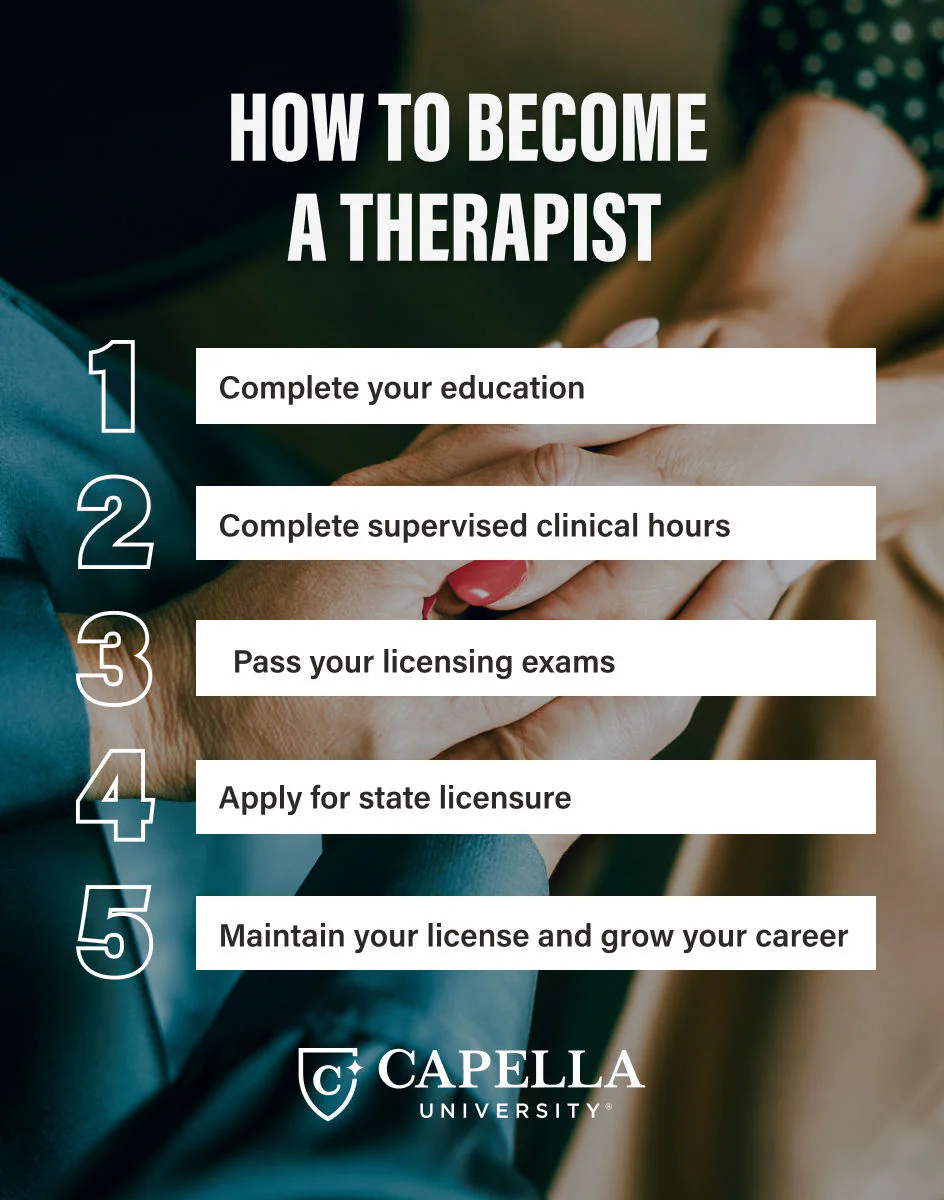
How to become a licensed therapist: step by step
Pursuing a career in therapy doesn’t have to mean putting your life on hold. Many aspiring therapists are already balancing work, family and other responsibilities while planning their next steps. Online coursework can help you work around your program’s in-person requirements.
Here’s a step by step look at one path toward becoming a therapist, from choosing your degree program to earning licensure and developing your career.